
Description
PrymaLab · Research Use Only
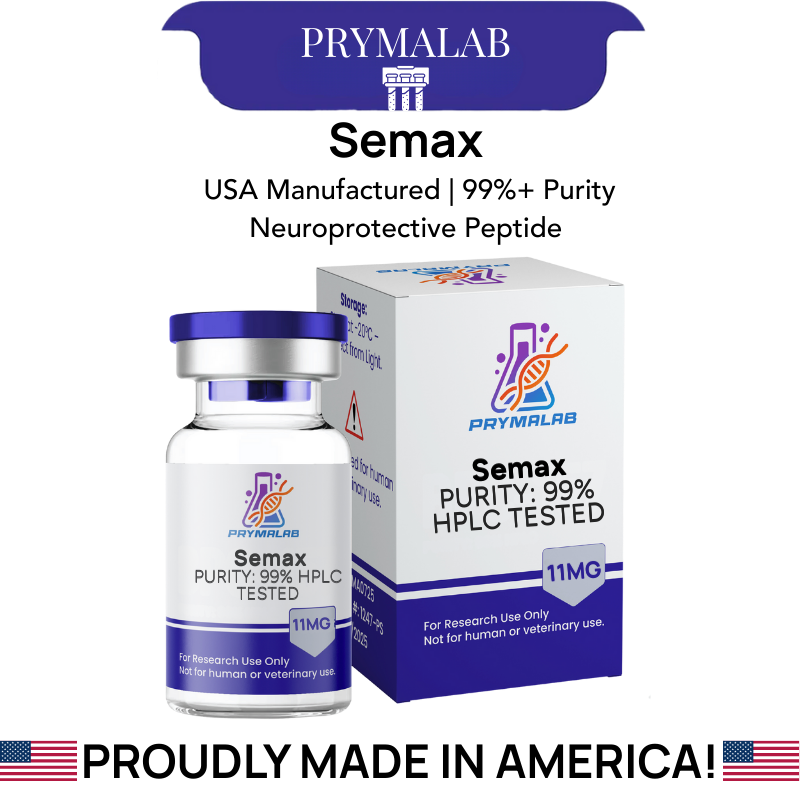
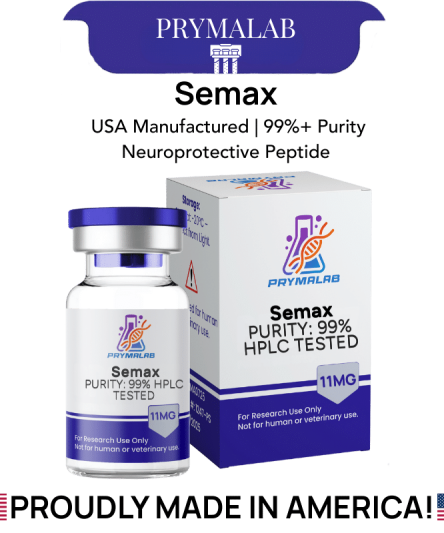
Semax 11mg
One residue governs the storage, the analysis and the shelf life
Semax peptide is seven residues and the first of them is a methionine. That one residue does more to determine how this vial has to be handled than anything else on the certificate, because methionine oxidises and the product is a different molecule.
Specification Table
| Property | Value |
|---|---|
| Compound | Semax |
| Residue count | 7 |
| Sequence | Met-Glu-His-Phe-Pro-Gly-Pro |
| Single-letter notation | MEHFPGP |
| Molecular weight, calculated | Approximately 813.9 g/mol for the free base |
| CAS | 80714-61-0 |
| Reactive residue | The amino-terminal methionine |
| Oxidation product | Methionine sulfoxide, adding sixteen daltons |
| Second oxidation | Methionine sulfone, adding a further sixteen |
| Proline residues | Two, both in the carboxy-terminal region |
| Aromatic residues | One phenylalanine and one histidine, so 280 nanometre detection is weak |
| Cysteine residues | None |
| Regulatory status | No approved formulation in the United States or the European Union |
| Appearance | White lyophilized powder |
| Storage, lyophilized | 2-8°C short term, -20°C for extended storage, protected from light and moisture |
What Does the Methionine in Semax Peptide Do?
Methionine is the residue that oxidises most readily of the twenty, and in semax peptide it sits at position one where it is most exposed.
The sulfur atom in the side chain accepts an oxygen to give methionine sulfoxide, and that reaction proceeds under conditions no laboratory considers harsh.
Dissolved oxygen is enough on its own. Trace metal ions accelerate it, light accelerates it further, and higher pH accelerates it again.
The mass change is sixteen daltons, which on an 814 dalton peptide is just under two percent.
A nominal-resolution instrument can miss that. A high-resolution one resolves it without difficulty.
A second oxidation is available, giving the sulfone and a further sixteen daltons, though it requires stronger conditions and is less common in ordinary storage.
The oxidised species is not a degraded version of semax peptide in the way a truncated chain would be.
It is a chemically distinct molecule that happens to share the same backbone, and whether it retains activity is a question the published record does not settle cleanly.
So a preparation that has partly oxidised is a mixture of two compounds in unknown proportion, and nothing about the appearance of the vial reveals it.
That is the argument for taking the storage requirements on this compound literally rather than as boilerplate.
How Would You Detect It?
Three methods establish whether semax peptide has oxidised, and they differ considerably in how much trouble they are.
High-resolution mass spectrometry is the direct route. Sixteen daltons on 814 is unambiguous where the instrument resolves it, and a mass sixteen high is a partly oxidised preparation rather than an impure one.
Reverse-phase chromatography is the practical route and often the more informative one.
Methionine sulfoxide is markedly more polar than methionine, so the oxidised species elutes earlier than the parent on a standard gradient.
On a fresh preparation the trace shows one peak. On an aged one it shows a shoulder or a second peak ahead of the main one, and the area of that peak is the extent of oxidation.
That makes the chromatogram a direct read of storage history in a way the mass figure is not, which is why the trace matters more than the percentage here.
The third method is to look at what the certificate does not say. A supplier quoting only a nominal mass has not measured whether oxidation occurred.
None of this is exotic and none of it appears on most certificates for this compound, which is the gap worth closing before ordering rather than after.
Asking for a chromatogram and the date the analysis was run is one question, and the interval between that date and the delivery date is itself informative.
What Else Is in the Sequence?
Two prolines sit in the carboxy-terminal half of semax peptide and contribute a smaller but real complication to the analysis.
Proline bonds interconvert between two geometries slowly enough that a column can resolve them as separate species, which broadens peaks and can produce shoulders.
On a molecule that already produces a real second peak from oxidation, that broadening makes the two effects harder to separate.
The practical consequence is that a shoulder on a semax peptide trace has two possible explanations and telling them apart needs the mass rather than the retention time.
An oxidised species is sixteen daltons heavier. A conformational species is the same mass as the parent.
Running the column warm sharpens the conformational contribution and leaves the oxidation peak where it is, which separates the two directly.
The aromatic content is thin. One phenylalanine and one histidine give some absorbance at 280 nanometres, considerably less than a tryptophan would.
Quantification at 214 nanometres is therefore the safer route here, as it is for most of this catalogue.
The sequence carries no cysteine, so there is no disulfide to form or break, which removes one class of problem entirely.
What Should a Semax Certificate Show?
A semax peptide certificate carries seven fields, and three exist because of the methionine.
The sequence written out. Seven residues is short enough to print and long enough that a substitution hides behind a trade name.
Observed mass against calculated mass, with the instrument resolution stated. Approximately 814 is the parent and approximately 830 is the sulfoxide.
Whether any oxidised species was detected, stated as a figure rather than left to inference from a purity percentage.
The chromatogram itself, since the oxidised species elutes ahead of the parent and its peak area is a direct measure of how much there is.
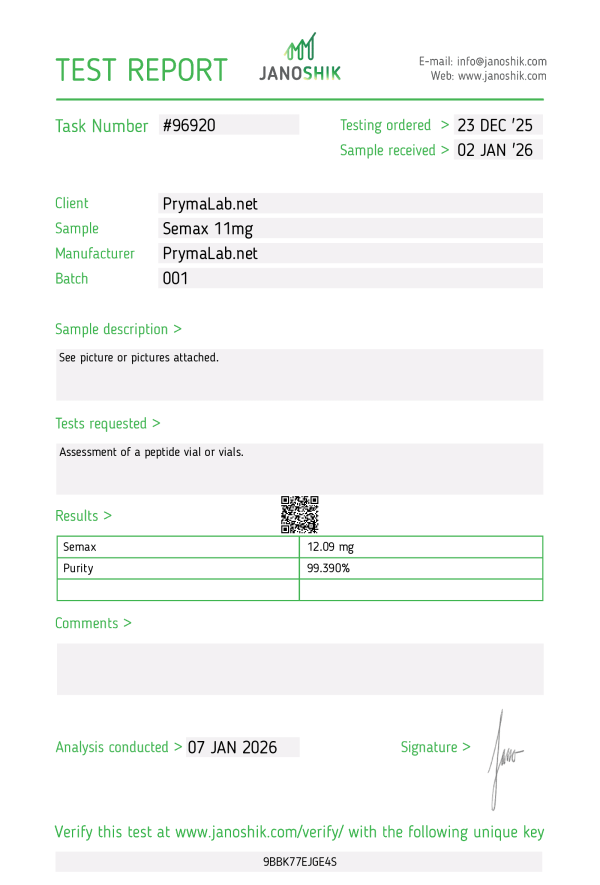
The date the analysis was run, which on this compound is more informative than on almost anything else in the catalogue.
Counterion identity and net peptide content. The sequence carries a glutamate and a histidine, so the salt form is not obvious and should be stated.
Lot number and synthesis date.
A certificate that reports an oxidised-species figure at all is unusual, and a supplier who offers one without being asked has understood the compound they are selling.
One further note on interpreting an oxidised-species figure when a certificate does provide one.
A low figure at the point of analysis says nothing about the material after shipping. Oxidation is a rate rather than a state.
The useful reading is the figure together with the analysis date, treated as a starting point on a clock rather than a property of the lot.
Why Does an 11mg Fill Matter Here?
Eleven milligrams is a large fill for a peptide used at the scale most work needs, and on this compound the size interacts with the chemistry.
A vial that lasts a long time is a vial that gets opened many times, and every opening admits atmospheric moisture and oxygen to the remaining cake.
For most peptides that is a minor accounting problem, corrected by reading net peptide content from the certificate.
Here it is a chemical problem, because oxygen is the reagent the methionine is waiting for.
The rate is low in the dry state and it is not zero, and it accumulates across a working life measured in months rather than days.
So a vial opened twenty times over a year is not the material the certificate described, and nothing about it will look different.
Two habits address that and neither costs anything.
The first is to record the number of openings alongside the date, which turns an invisible variable into a recorded one.
The second is to reconstitute the whole vial once and aliquot it, rather than returning to the dry cake repeatedly.
That trades a solid-state problem for a solution-state one, which sounds like a poor exchange and is not, because frozen aliquots in the dark are more stable than a repeatedly opened cake.
Where a study is short and small, the smaller fill available in this range is the better purchase for exactly this reason.
How Should the Vial Be Handled?
Every handling instruction for semax peptide traces back to the same residue, which makes them easy to remember.
Sealed lyophilized powder holds at 2 to 8 degrees Celsius briefly, and at minus 20 for longer, kept dark at every stage including the bench.
The dry state is considerably more stable than solution, because oxidation needs dissolved oxygen and a dry sealed cake has very little available to it.
Bring the vial to ambient temperature before opening, since the powder is hygroscopic and condensed water brings dissolved oxygen with it.
Reconstitute down the wall and swirl rather than shake, because vigorous agitation entrains air and air is the one thing this molecule least needs.
Aliquot on first reconstitution and keep the aliquots dark and cold. Every hour a solution spends at ambient temperature in the light is oxidation time.
Avoid metal contact where practical. Trace transition metals catalyse the reaction, and a stainless steel needle in a solution for a few seconds is not the problem while a metal-contaminated buffer is.
Use low-binding consumables at working dilutions, since adsorption removes a measurable fraction of dilute peptide into ordinary plastics.
Record lot, net peptide content, diluent, date of first reconstitution and any oxidised-species figure from the certificate. That last field is the baseline against which later analysis is read.
One last note on what a second laboratory needs from the record.
Oxidation is the only degradation route that matters much on this compound, and it is entirely a function of exposure rather than of elapsed time alone.
A vial stored cold and dark for a year is in better condition than one left on a bench for a fortnight, and only the record distinguishes them.
Writing down where the material was kept, not just how long, is what makes that judgement possible later.
Freezer, fridge or bench is three words in a notebook, and it is the difference between a result somebody can defend and one they can only report.
Published Literature
Selected references on this compound and on the methionine chemistry that governs its handling.
- Dolotov OV, Karpenko EA, Inozemtseva LS, Seredenina TS, Levitskaya NG, Rozyczka J, et al. Brain Research. 2006;1117(1):54-60. DOI: 10.1016/j.brainres.2006.07.108
- Levitskaya NG, Sebentsova EA, Andreeva LA, Alfeeva LY, Kamenskii AA, Myasoedov NF. Neuroscience and Behavioral Physiology. 2004;34(4):399-405. DOI: 10.1023/B:NEAB.0000018751.32240.5f
- Manning MC, Chou DK, Murphy BM, Payne RW, Katayama DS. Pharmaceutical Research. 2010;27(4):544-575. DOI: 10.1007/s11095-009-0045-6
- Chu JW, Yin J, Wang DIC, Trout BL. Biochemistry. 2004;43(4):1019-1029. DOI: 10.1021/bi0356000
Frequently Asked Questions
What is semax peptide?
A seven-residue synthetic peptide with the sequence Met-Glu-His-Phe-Pro-Gly-Pro, written MEHFPGP, calculated at approximately 813.9 daltons for the free base.
Why does the methionine matter?
It is the residue that oxidises most readily of the twenty and it sits at position one, where it is most exposed. The sulfur accepts an oxygen to give methionine sulfoxide.
What conditions drive that?
Nothing harsh. Dissolved oxygen is enough, trace metal ions accelerate it, light accelerates it further, and higher pH accelerates it again.
How large is the mass change?
Sixteen daltons, just under two percent on an 814 dalton peptide. Small enough for a nominal-resolution instrument to miss and large enough for a high-resolution one to resolve easily.
Is the oxidised form just degraded material?
No. It is a chemically distinct molecule sharing the same backbone, and whether it retains activity is not settled cleanly in the published record.
How is oxidation detected?
By high-resolution mass, or more practically by chromatography. Methionine sulfoxide is markedly more polar, so the oxidised species elutes ahead of the parent on a standard gradient.
Why is the chromatogram better than the mass figure?
Because the peak area gives the extent of oxidation directly, which makes the trace a read of storage history rather than a single yes or no.
What do the two prolines add?
Peak broadening. Proline bonds interconvert slowly enough for a column to resolve them, which can produce shoulders that look like the oxidation peak.
How do you tell those two apart?
By mass. An oxidised species is sixteen daltons heavier and a conformational species is the same mass as the parent. Running the column warm also sharpens the conformational contribution.
Can it be quantified at 280 nanometres?
Weakly. One phenylalanine and one histidine give some absorbance and considerably less than a tryptophan would, so 214 nanometres is the safer route.
Why does the analysis date matter here?
Because oxidation accumulates with time. The interval between the analysis date and the delivery date tells you how much of the storage history the certificate does not cover.
What is the single most useful storage habit?
Keeping solutions dark and cold and aliquoting on first reconstitution. The dry sealed state is considerably more stable, because oxidation needs dissolved oxygen and a dry cake has very little.
Compliance Statement
Semax peptide is sold exclusively for laboratory research use. It is not a drug, food, or cosmetic product, and it is not a dietary product of any kind. It is not approved by the FDA or any comparable authority for human or veterinary use, the amino-terminal methionine oxidises under ordinary storage conditions to a chemically distinct species whose activity the published record does not settle, and no compound in this range is offered for any human or veterinary purpose. This product is not intended to diagnose, treat, cure, or prevent any disease. It must not be given to humans or animals. Purchase is restricted to qualified researchers and institutions operating within applicable laws. All handling is the responsibility of the purchasing laboratory.
Other formats of Semax
Semax is also stocked as Semax 1mg/ml preloaded 3ml pen, Semax 10mg Nasal Spray and Semax 5mg. Each listing states its own quantity and concentration, and the pen and vial comparison explains what changes between formats.










20 reviews for Semax 11mg